As a festive meal approaches, the choice often comes down to a few seconds in front of the label. Between a “traditional” Foie Gras, a “whole” one, an IGP Sud-Ouest or a simple artisanal promise, it’s not always easy to know what really justifies quality. If you’re wondering how to choose a quality artisanal Foie Gras, this complete guide starts with a simple idea: a great product is first and foremost recognized by its origin, its composition and the rigor of its preparation.
How to choose a quality artisanal Foie Gras according to its origin
The first reflex is to look at where the product comes from. For quality artisanal Foie Gras, the French origin remains a strong benchmark, but not all French products are created equal. What counts is the real traceability of the ducks or geese, the place of processing and respect for identified know-how.
The IGP Sud-Ouest label is an excellent indicator of this. It’s not just a marketing ploy. It guarantees a link with a recognized terroir, precise production criteria and consistently high standards. For a buyer who wants to offer or serve a refined product without making mistakes, it’s often the clearest sign.
Conversely, a vague origin, or vague formulations such as “elaborated in France” with no further details, should invite caution. An artisanal Foie Gras worthy of the name has nothing to hide about its origin.
You can also find a fine selection of products on the page dedicated to artisanal Foie Gras.
Read the ingredient list before you do anything else
This is often where the difference is made between an authentic product and a standardized one. A quality artisanal Foie Gras has a short, clear and reassuring composition. Ideally, you’ll find essentially Foie Gras, salt, pepper and a touch of seasoning if the recipe is fragrant.
The fewer ingredients, the better. The addition of additives, preservatives, colorants or artificial flavors has no place in a high-end approach. These elements can mask a banal raw material or aim for prolonged preservation to the detriment of the product’s natural expression.
There’s also a nuance to accept. Some festive recipes include spirits, figs, sweet peppers or truffles. This is not a fault, as long as these ingredients serve the Foie Gras and not the other way round. A successful original recipe should enrich the tasting experience, not compensate for a lack of quality.
Whole, block, semi-cooked, canned: which shape to choose?
To understand how to choose a quality artisanal Foie Gras, we need to distinguish between the main product families. Whole Foie Gras is generally the noblest reference. It’s made up of one or more whole lobes, and offers a finer texture, a more elegant cut and a clearer indication of craftsmanship.
Bloc de Foie Gras may be suitable for certain uses, such as toasts or large-scale receptions, but it generally has a more homogeneous, less nuanced structure. It’s not necessarily bad, just less prestigious.
The choice also depends on the moment of tasting. Semi-cooked Foie Gras seduces with its melt-in-the-mouth texture and fresh aromatic expression. On the other hand, it requires stricter preservation and more careful logistics. Preserves, on the other hand, offer an excellent compromise for distance purchasing, storage and even the evolution of flavors over time. A very good Foie Gras in a verrine can gain in complexity after a few months.
For an elegant meal or a gourmet gift, the whole Foies Gras range is often the safest choice.
Visual and sensory signs that can’t be mistaken
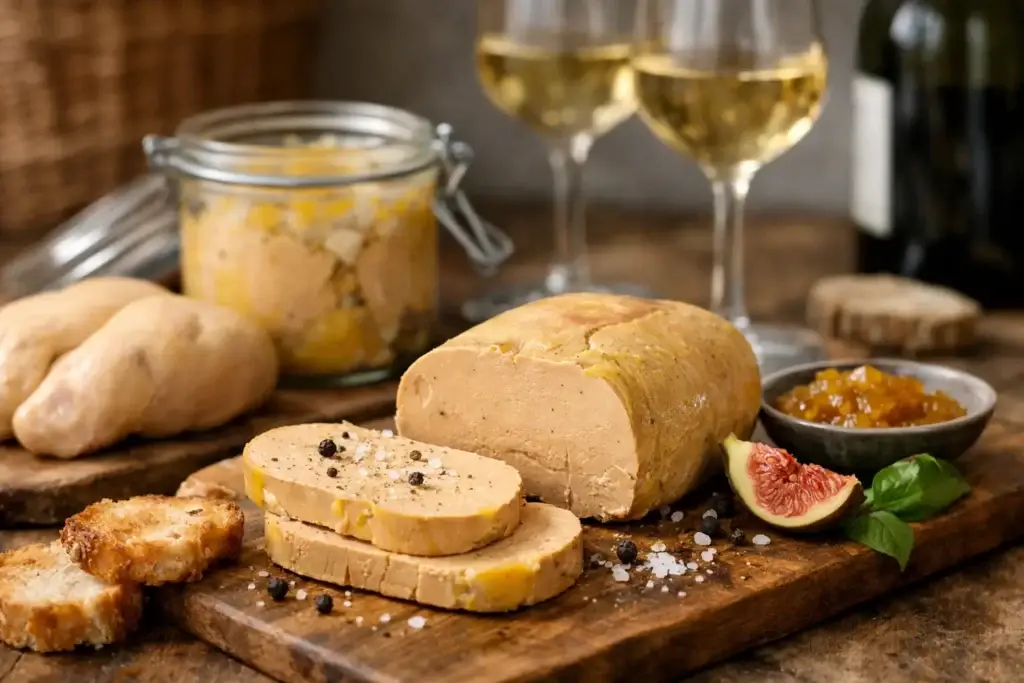
Even before tasting, a quality Foie Gras speaks volumes. Its color should be natural, ranging from ivory to pinkish-beige, depending on recipe and cooking method. A hue that is too uniform or too deep can sometimes indicate an over-worked product.
Texture is just as important. A good Foie Gras should be neither rubbery nor excessively oily. Slight degreasing is normal, especially in artisanal products, as the material lives on. On the other hand, too much melting can reveal a poorly selected foie gras or a poorly controlled cooking process.
On the palate, look for balance. The flavor should be clean, full-bodied and long, with no aggressive saltiness. Fatness should melt away elegantly, without leaving a heavy sensation. It’s this point that makes the difference between a simply festive product and a true gastronomic experience.
The word “artisan” is not enough on its own
Many labels use the term “artisanal”, but not all justify it in the same way. True craftsmanship can be recognized by a number of tangible indicators: small batches, hand selection, traditional preparation, measured seasoning and transparency of production methods.
A serious company also highlights its commitments with precision: 100% French, natural ingredients, no additives, recyclable verrines, quality control, accessible customer service. This clarity inspires confidence, especially when buying online.
In this respect, the consistency of the offer is also important. A specialized company that offers classic, fruity or more original recipes, without abandoning its quality criteria, demonstrates more credible expertise than a generalist brand.
Lovers of refined variations can explore recipes and assortments on the Foie Gras assortments collection.
Good Foie Gras also depends on use
There’s no such thing as one great Foie Gras, but several good choices depending on the situation. For a New Year’s Eve appetizer, choose a whole Foie Gras with a classic profile, capable of appealing to the widest possible audience. For an apéritif dînatoire, a smaller format or an assortment allows you to vary the pleasures without waste.
For a gift, presentation becomes almost as important as the product. A beautiful verrine, a well-kept box, a strong house identity and a promise of French manufacture immediately reassure. In a professional context, consistency and perceived quality are essential: the gift must be as pleasant to receive as it is to taste.
If you’re looking for a ready-to-give solution, the gourmet gift box category is just the thing.
Buying online without making a mistake
Buying artisanal Foie Gras on the Internet requires a few simple checks. The first concerns the quality of the information available. A reputable website will specify the origin, composition, type of Foie Gras, storage conditions and delivery details. The clearer the product sheet, the more trustworthy the company.
Also look for reassurance. Secure payment, toll-free contact, clear delivery terms, a commitment to quality and verified customer reviews are good indicators. A premium seller isn’t content with pretty pictures. He accompanies the purchase with proof.
It is also useful to assess the overall coherence of the proposed universe. A company that masters its pairings, recipes, service ideas and complementary products often demonstrates a true gastronomic culture. This is the spirit in which Relais Gourmet builds its offer, with particular attention paid to naturalness, French origin and artisanal excellence.
The right price: neither suspicion nor illusion
A quality artisanal Foie Gras cannot be a product that is permanently sold out. Foie Gras selection, French production, compliance with exacting specifications and manual labor all come at a price. An abnormally low price should therefore raise questions.
However, the most expensive is not always the best. What counts is consistency between price, origin, composition, format and level of presentation. An IGP Sud-Ouest verrine, with no additives, prepared by hand, can offer remarkable value even if it’s not at the top of the range.
The right purchase is the one that meets your needs with sincerity. For a grand dinner, you’ll gladly invest in a whole from a fine source. For a refined aperitif or a discovery, a well-thought-out assortment may be more appropriate.
When you choose a great Foie Gras, you’re choosing a company you can trust as much as a product. When the origin is clear, the recipe short, the know-how visible and the tasting experience up to scratch, the pleasure owes nothing to chance. That’s where true gourmet pleasure begins: in the certainty of offering, or sharing, a fair, authentic and profoundly French product.