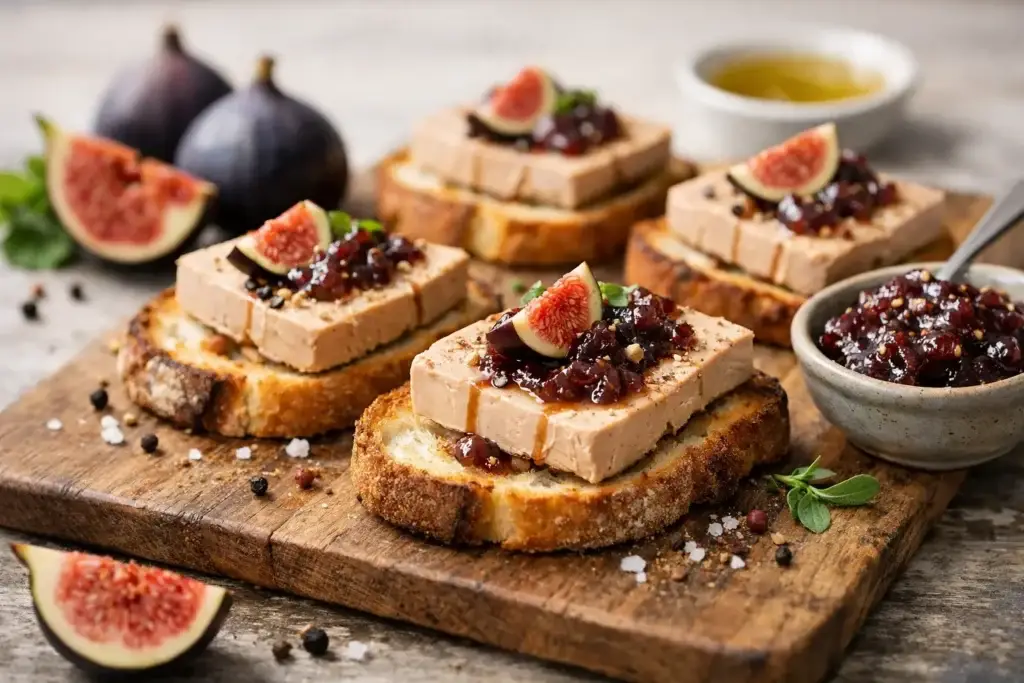
A good foie gras toast with figs doesn’t forgive carelessness. Bread that’s too hot will melt the slice, figs that are too sweet will overwhelm the finesse of the foie gras, and seasoning that’s too strong will mask all the charm of an exceptional product. Conversely, when the balance is just right, a few bites are enough to create a real festive atmosphere.
The marriage of foie gras and fig is one of those pairings that seems obvious, but actually requires a certain precision. The fruit brings a round sweetness, a slight candied note and a tender texture that respond very well to the richness of the foie gras. It’s just a question of choosing the right size, the right bread and the right moment to serve it.
why foie gras with figs for toast works so well
Foie gras has a melt-in-the-mouth texture, a delicate length on the palate and long-lasting aromas. Figs, on the other hand, have it both ways. It offers sugar, of course, but also a hint of herbs and a supple texture that avoids the overly dry effect sometimes associated with toasted bread.
This pairing works particularly well as an aperitif because it’s easy to follow. In a single mouthful, you perceive the sweetness of the fruit, the depth of the foie gras and the crispness of the base. It’s refined without being complicated. It’s also a very useful combination when you want to offer a tasting experience that’s accessible to guests who aren’t necessarily used to plain foie gras.
There is, however, a word of caution. If the fig dominates too much, the toast quickly loses its elegance and becomes jammy. That’s why it’s better to look for a fig that’s present but measured, or a subtly perfumed foie gras, rather than an assembly that’s too demonstrative.
which foie gras with figs to toast
Not all foies gras lend themselves equally well to service on toast. For a clean, gourmet result, whole foie gras is often the best choice. Its texture is nobler, its cut sharper, and its aromatic expression more precise. On a small toast, this difference is immediately apparent.
Artisanal, 100% French foie gras, prepared without additives, preservatives or colorants, also makes for a purer mouthfeel. When the recipe is simple and the know-how well mastered, the pairing with figs gains in finesse. The origin counts, as does the method of preparation. An IGP Sud-Ouest foie gras provides the guarantee of traceability and regularity that discerning connoisseurs are looking for.
If you’re hesitating between a plain foie gras and a version with figs, it all depends on the tasting style you’re looking for. A recipe that has already been prepared with figs simplifies the presentation and ensures aromatic consistency. A plain foie gras, on the other hand, leaves more freedom in the choice of bread and accompaniment. For a quick but carefully prepared aperitif, the fig version is often the most comfortable. For a more personalized tasting experience, plain foie gras may be preferable.
To discover different styles of artisanal foies gras, the company offers a dedicated selection on https://www.relaisgourmet.com/12-foies-gras-entiers.
whole, semi-cooked or canned: what’s different about toast?
The mi-cuit seduces with its mellowness and fresh expression. It is remarkable when served immediately, as long as the temperature is controlled. On toast, it requires a little delicacy, as it may score more quickly when served.
Properly prepared, canned foie gras offers a slightly denser texture, often ideal for aperitif toasts. It slices well, withstands handling better and develops rounder aromas over time. When entertaining several guests, it’s often a very safe choice.
the ideal bread for toasting foie gras with figs
Bread is more than just a support. It conditions the overall texture of the bite, and can either enhance or unbalance the whole. With foie gras with figs, we generally look for a discreetly flavored bread, with enough hold to carry the product without breaking it.
The lightly toasted country bread works very well. It adds a measured crispness and an interesting natural acidity. Brioche bread, on the other hand, creates a more gourmet, enveloping tasting experience. It’s an excellent choice for the holidays, but you must be careful not to add an overly sweet fig on top.
Gingerbread may be a good match, but only if you like strong harmonies. Its aromatic profile quickly takes over. For many palates, it’s fairer to reserve it for a one-off tasting than for an entire aperitif platter.
The thickness of the toast also counts. Too thin and it breaks or dries out the bite. Too thick, it tires the palate and reduces the sensation of melting. A thin but stable slice, toasted through without excess, gives the best results.
how to prepare an elegant toast without masking the product
The first thing to do is to take foie gras out of the fridge just before serving, without letting it overheat. A few minutes is often enough for the texture to become suppler and the aromas to open up. Served too cold, it appears closed. Served too hot, it loses its hold.
The toast should be cold or barely warm when assembled. This is a decisive detail. If the bread is still warm, the surface of the foie gras will melt and the presentation will be less clear. For a refined service, it’s best to toast the bread in advance, then let it come to temperature.
When it comes to garnish, restraint is your best ally. A thin slice of rehydrated dried fig, a micro-spoonful of fig confit, or a few slivers of fresh fig when in season are all you need. Adding pepper, fleur de sel and plenty of fruity garnish often leads to a talkative toast. Here, you need to let the product breathe.
For those looking for other ideas for aperitif accompaniments, the range of speciality spreads offers interesting alternatives at https://www.relaisgourmet.com/15-aperos-gourmet.
the right portion size
On an aperitif toast, a portion that’s too generous isn’t necessarily the most pleasant. It’s better to have a well-balanced bite than one that’s too thick and crushes on first contact. In practice, a clean slice or a very measured quenelle helps to maintain the finesse of the service.
It’s also what makes the difference between a distinguished aperitif and a busy buffet. Foie gras calls for a form of precision. It doesn’t need to overdo it to be noticed.
what to serve with these toasts
The best accompaniment is not always the most spectacular. With foie gras with figs, it’s important not to overdo the sweet notes. If the toast is already garnished with figs, there’s no need to add strong chutneys or sugar-rich compote.
A sweet wine can be very pleasant, but it depends on the profile of the foie gras and the time of the meal. As an aperitif, some prefer a crisper white or a taut champagne to lighten the mouth. The right match often depends on the quantity served and the rest of the menu. On two or three toasts, freshness is often welcome. On a more settled starter, a rounder pairing may be appropriate.
For a more complete gourmet experience, you can also combine these toasts with a festive assortment like those presented on https://www.relaisgourmet.com/30-coffrets-cadeaux. This is a particularly suitable solution when entertaining or when you wish to offer an experience that has already been thought through in terms of balance.
the most frequent errors
The first mistake is trying to do too much. Foie gras, figs, gingerbread, chutney, fleur de sel, pink berries, balsamic reduction: on paper, it all looks festive. On the palate, it often becomes confusing. The foie gras loses its central place.
The second mistake is to neglect the quality of the product. A foie gras with figs for toast doesn’t need any tricks if it’s well selected. French, natural, artisanal production really changes the final result. With such a simple product to serve, every detail is visible and tasty.
The third mistake is timing. Assembling the toast too early soggyens it. Assembling them at the last minute, without prior preparation, puts unnecessary strain on the service. The most comfortable approach is to prepare the bread, toppings and presentation dish in advance, then set up just before the guests arrive.
when to propose these toasts
We spontaneously think of the end-of-year festivities, and rightly so. However, foie gras with figs on toast can be used for many other occasions: a birthday aperitif, a family reception, a dinner with friends or a gourmet gift to share. Its advantage is that it immediately creates an impression of care and generosity, without requiring complex preparation.
For those who wish to take the art of serving foie gras a step further, dedicated accessories can help you achieve greater precision, particularly when cutting and presenting: https://www.relaisgourmet.com/18-ustensiles.
At Relais Gourmet, this spirit of tasting is based on a simple conviction: when the product is authentic, well prepared and served with precision, there’s no need to overdo it. A well-thought-out toast, a beautiful fig, a quality foie gras, and the table immediately takes on a different allure.