
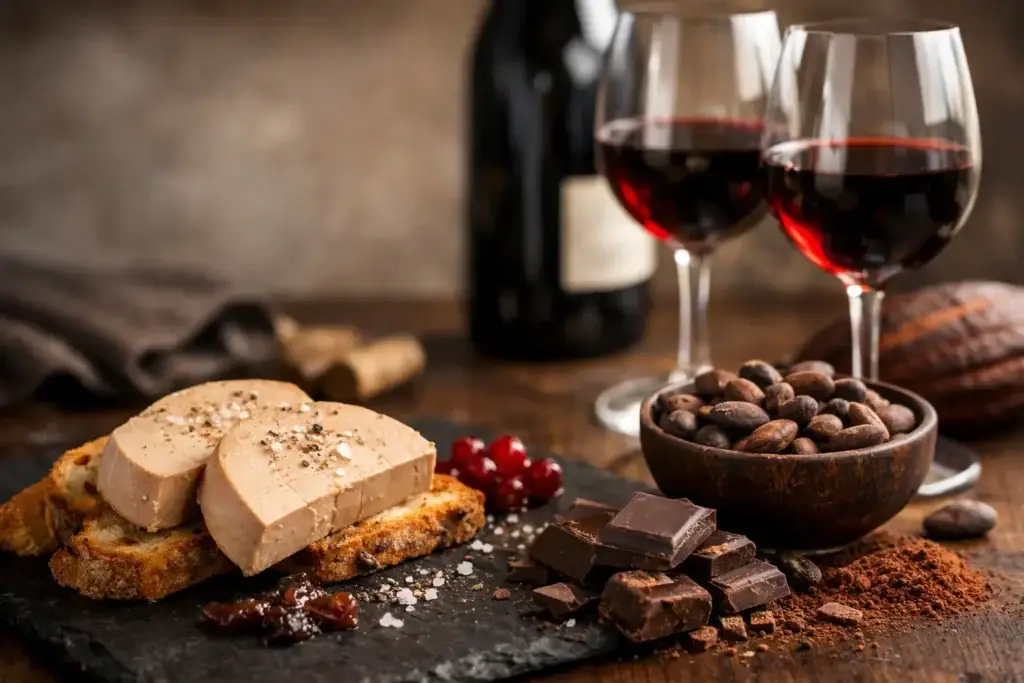
Served too cold, foie gras closes up. Combined with cocoa that’s too bitter, it hardens the palate. And chosen with a wine that’s too powerful, it loses the silky length that gives it its charm. So pairing foie gras with cocoa and wine is less a fashion statement than an exercise in precision.
When successful, it brings a rare depth. The noble fatness of the liver calls for the gentle bitterness of the cocoa, then the wine links the whole, either prolonging the roundness or creating a clear contrast. It’s a festive trio, but also a demanding pairing. It rewards the right products, measured doses and real attention to service.
foie gras cacao wine pairing: what really works
The first principle is simple: think texture before you think power. Foie gras has an enveloping, delicate, almost creamy texture, depending on the preparation. Cocoa, on the other hand, can range from discreetly velvety to dryly bitter. The wine must bridge the gap without overpowering either.
With traditional whole foie gras, cocoa works better as a touch than as a dominant feature. A fine powder on a slice, a lightly cocoaed bread or a lightly sweetened cocoa reduction may suffice. If the cocoa becomes massive, it takes over and transforms the pairing into a demonstration, whereas what we’re looking for here is a feeling of continuity.
The wine then depends on the style you’re looking for. A sweet wine brings immediate harmony. A well-chosen dry white wine, on the other hand, can soften the match and give it greater depth. A red wine is possible, but only if it’s supple, low in tannin and very controlled.
This is also why the quality of foie gras is so important. An artisanal, 100% French product, with no additives or preservatives, offers a clearer reading of flavors and leaves more room for pairing. With over-seasoned or over-standardized foie gras, cocoa and wine tend to compensate for flaws rather than interact.
which cocoa to choose with foie gras
Not all cocoa tells the same story. A lean, very bitter cocoa accentuates the metallic sensation of certain wines and dries out the finish. On the other hand, milk chocolate or chocolate with too much sugar blurs the finesse of foie gras. The right register is often somewhere in between.
The ideal cocoa is not very sweet, with round, toasty, slightly woody notes, without excessive bitterness. We’re not looking for a dessert. We’re looking for an aromatic punctuation. A pinch of pure cocoa on foie gras at serving temperature may be enough. The gesture should remain light.
If you’re working on the match at the table, the support also counts. A discreetly toasted country loaf, a lightly sweetened fig loaf, or a lightly buttered brioche loaf can accompany the whole. But here again, it’s important to avoid accumulation. Foie gras, cocoa, wine, bread, chutney, fleur de sel: five aromatic cues or more will confuse the pairing.
For a more controlled approach, it may be wise to start with a foie gras already oriented towards fruity or spicy notes. A selection of whole foies gras, for example, allows you to choose a more classic or more original base, depending on the wine you’re considering. This is often the best method: build the match from the main product, then adjust the rest.
the best wine styles for this pairing
softness, the most natural option
This is the best-known pairing, and is still very convincing, provided you avoid overly heavy vintages. A good mellow wine adds bind, rounds out the cocoa and accompanies the natural sweetness of foie gras. However, freshness must be preserved. Without acidity, the whole can quickly become thick.
Young, sweet white wines, with their hints of candied fruit, apricot and sometimes a hint of discreet honey, are often more accurate than more mature versions. With cocoa, they create an impression of fine ganache, but in a salty version.
dry white, for a more gastronomic match
This is the choice of tables that want more tension. A dry white with good substance, precise acidity and discreet ageing can work very well. It cleanses the palate and avoids saturation. With moderate cocoa, the result becomes more chiselled, more contemporary in spirit.
It all depends on the seasoning of the foie gras. If it’s sober, a dry white wine has plenty of room. If it’s flavored with sweet spices or fruit, it’s best to return to a more enveloping wine.
red, only in certain cases
Yes, a red wine can work, but not just any red wine. It needs few tannins, little marked wood and lots of suppleness. Cocoa already creates a sensation of dark matter. If red adds a firm structure, foie gras seems shorter and less elegant.
A light red, with mellow tannins, black fruit and sweet spices, may be a good match for foie gras with a clearer cocoa note. It remains a connoisseur’s pairing, interesting but less universal.
foie gras cacao wine pairing according to serving style
Pairings vary greatly depending on the shape of the dish. As an aperitif, with a small bite, you need to go for legibility. A thin slice of foie gras, a hint of cocoa and a wine by the glass are all you need. The idea is to arouse desire, not to saturate the palate in the first few minutes.
For starters, you can add a little complexity. A plate with foie gras, toasted bread, discreet dry fruit and finely-dosed cocoa allows for a more nuanced wine. This is where well-balanced sweet whites and certain gourmet dry whites come into their own.
Whether as a gift or a reception meal, it’s best to think in terms of practicality and consistency. A well-chosen assortment makes it possible to vary experiences without losing the thread of the tasting. Gift boxes are useful in this respect, especially when you want to offer a complete, refined experience without improvising at the last minute.
the most frequent errors
The first mistake is to confuse cocoa with chocolate. Chocolate adds sugar, fat and sometimes vanilla. Pure cocoa, on the other hand, acts primarily on bitterness and roasted aromas. It’s a completely different lever.
The second mistake is to serve foie gras too cold. Once out of the fridge, its texture remains firm and its aromas are muted. You need to let it warm up slightly to develop its finesse. Otherwise, the wine appears harder and the cocoa more brittle.
The third mistake is to overdo it. Marked jam, sweet bread, abundant fleur de sel, cocoa and a rich sweet wine often lead to a heavy pairing. Here, refinement comes from restraint.
The fourth, more discreet error is to neglect the order of tasting. Take a small bite of foie gras, let the texture come, then add the cocoa note, then the wine. If everything arrives at once, the palate receives a mass. If you respect the progression, you get a clear and much more elegant reading.
build a home accord with quality products
To succeed, you don’t need to multiply your references. A very good foie gras, well-chosen cocoa, the right bread and the right wine are all you need. This is often where naturalness and French origin make the difference: a product made with respect for taste, with real know-how, is better suited to precise pairings.
If you’re preparing a festive meal, you can also explore ideas for accompaniments on the blog, or complete your table with a few spreadable gourmet aperitifs, taking care to maintain a clear taste line. At Relais Gourmet, this approach is based on a simple requirement: to make gastronomic pleasure a safe, authentic and accessible experience at home.
When it comes down to it, it’s not about finding the most spectacular pairing. It’s to find the one that allows the foie gras its nobility, the cocoa its subtlety, and the wine its role as hyphen.