
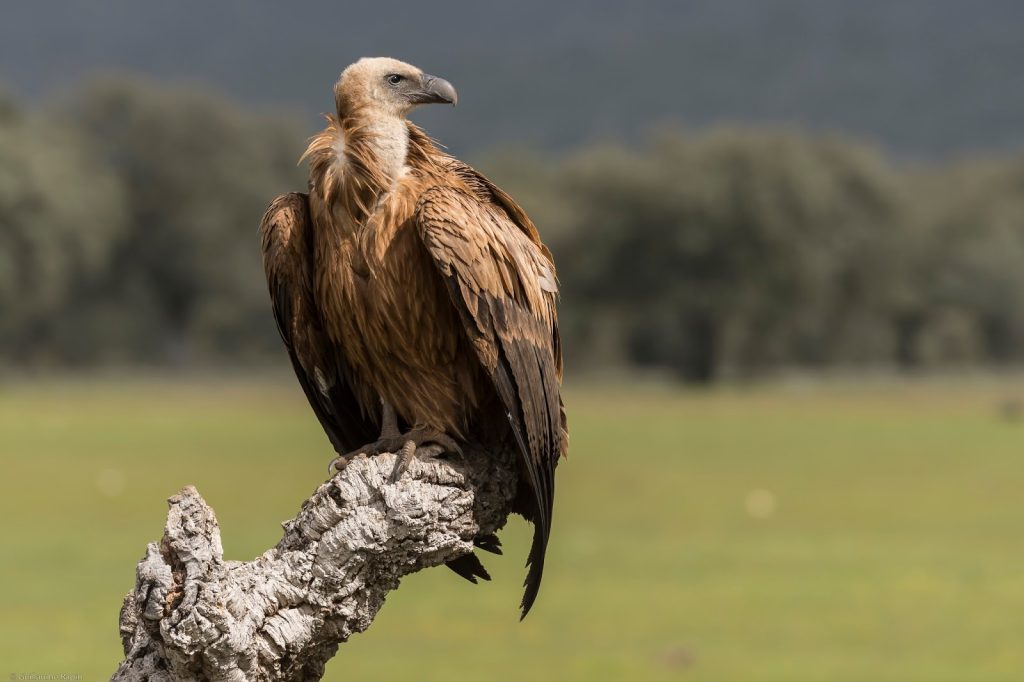
There are times when you spot a griffon vulture in the sky over the western Pyrenees . Its majestic flight immediately attracts attention. This scavenging bird of prey is said to be the king of the summits, but it is also the emblematic bird of the Basque country. Summer, like spring, is the ideal season to observe it. It is during these seasons that the bird reproduces.
The griffon vulture, a typical animal of the Pyrenean mountains, at .
On April 6, 2019, the Ustaritz-based association Hegalaldia organized a vulture banquet in Bussunarits-Sarrasquette, in collaboration with the Centre permanent d’initiatives pour l’environnement (CPIE) and the Département du Pays Basque. The Griffon vulture was also in the spotlight. The theme of the event focused on the link between vultures and pastoralism. Circumstances such as these provide an opportunity, weather permitting, to witness the release of the griffon vulture. It’s an eloquent gesture that reflects the preservation of this necrophagous bird typical of the Pyrenean mountains. At the same time, you can sample some typical local dishes at a buffet. We take part in recreational workshops while observing the vultures. All of which goes to show that vultures, and more specifically griffon vultures, are important to the people of the Pyrenees. So go to the Atlantic Pyrenees and the Hautes-Pyrénées for your best chance of seeing them.
The home of griffon vultures
These large birds of prey, ranging in size from 95 to 105 cm and weighing between 8 and 11 kg, like to make their home on rocky escarpments. They nest in the lower parts of mountains, alongside large valleys, plains, high plateaus and causses. The refuge of these gregarious birds can be recognized by the ledges carved into the rock faces. Underneath, they build cavities to protect themselves from predators. Access is unobstructed. This is where these gliding birds take off and land. As for their nest, they build it on cliffs, preferring limestone environments. As they nest in colonies of around 15 to 20 pairs (note that griffon vultures are monogamous), the shortest distance between two nests can be less than 2 m.
The reproduction of griffon vultures
A pair of griffon vultures is said to be united until one of them disappears. They make nuptial flights close to their breeding site and dormitory. These are synchronized flights, in tandem, following the rock face. One flies above the other. Mating, nesting and construction of the nesting area using feathers and branches generally begin in November. The egg-laying season is from the end of the year to early March. Griffon vultures lay just one egg. The luckiest ones lay two, but this is rare. Incubation lasts between 53 and 54 days. When the chick hatches, it remains in its nest for around 120 days. Both parents raise the chick before it flies away, but even if it does fly away, its parents still feed it for one or two months.
Find out more interesting facts about Pays Basque on our Blog!